9 min reading
As cryptocurrency payments become part of the broader payment landscape, businesses have more ways to accept digital assets than ever before. The challenge in 2026 is no longer simply finding a provider that supports crypto, but understanding which crypto payment gateway fits the way a particular business operates.
How does a crypto payment gateway work?
Modern crypto payment gateways differ not only in fees and the number of supported assets. Some services focus on e-commerce and ready-made plugins, others on APIs and complex platform scenarios, while some emphasize stablecoin payments or give businesses greater control over the underlying infrastructure.
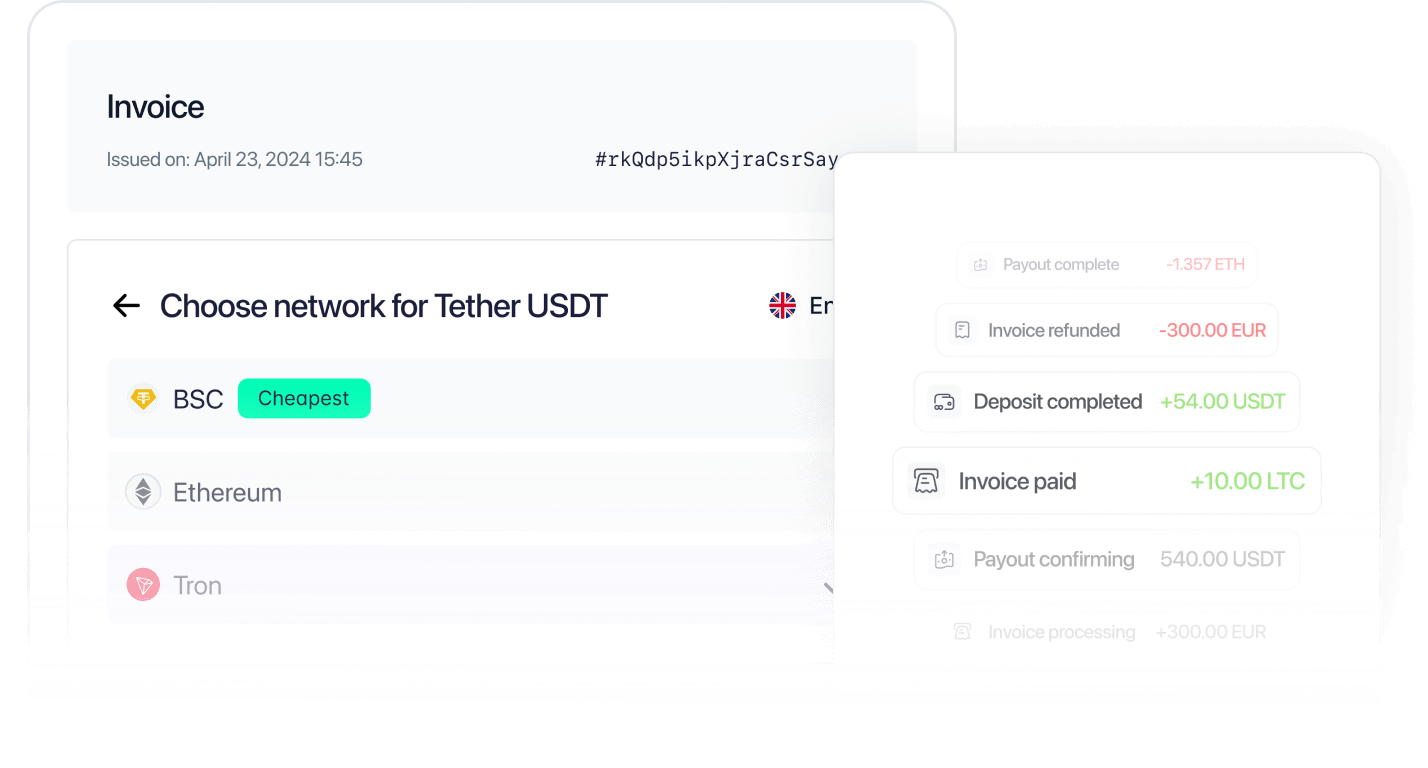
A crypto payment gateway is an infrastructure layer between the merchant and blockchain systems. In a typical scenario, the client selects cryptocurrency as a payment method, and the merchant creates an invoice or payment request through the gateway. The provider calculates the amount in the selected cryptocurrency and provides the client with the payment address, network, and other details.
After the funds are sent, the gateway tracks the transaction on the corresponding blockchain network. Once the payment reaches the required confirmation status, the provider updates the invoice and sends the update to the merchant's system, for example, through a webhook or API. The business system can then confirm the order, activate a subscription, issue a digital product, or perform another action. Depending on the settlement settings, the received funds can remain in crypto or be converted into a stablecoin or fiat currency.

The biggest differences between providers usually emerge beyond checkout. Key areas include exchange rates, confirmation logic, refunds, expired invoices, settlement options, compliance procedures, and exception handling. This is why choosing a gateway solely based on the number of supported cryptocurrencies is not enough: the entire payment flow matters, from checkout to settlement and reconciliation.
What to consider when choosing a crypto payment gateway
Before comparing specific services, it's worth defining several criteria. First, consider settlement. A business may accept Bitcoin or USDC, but that doesn't mean it needs to hold these assets after payment. Some providers automatically convert incoming crypto into fiat, stablecoins, or other supported currencies, so it's important to understand what the business ultimately wants to receive.
The integration model and supported assets and networks are equally important. A small online store may be able to use a ready-made plugin, while a platform with its own checkout, billing system, or user balances will likely need an API and webhooks. When it comes to asset coverage, what matters most is whether the provider supports the cryptocurrencies and networks the merchant's customers actually use.
Compliance and regulatory status should also be considered, especially for companies operating in the EU. At the operational level, it's worth finding out in advance how the provider handles underpayments, overpayments, expired invoices, delayed confirmations, refunds, and wrong-network transactions.
Sheepy - for flexible merchant flows
Sheepy is a crypto payment gateway for companies that need to integrate cryptocurrency payments into their existing checkout, billing system, or platform flow. A merchant can accept cryptocurrency, track payment statuses via API, and use various settlement models. For technical integrations, Sheepy provides separate Sandbox and Production environments, with testing required before production access.
Sheepy's strength lies not in a single checkout scenario, but in a set of tools designed for different business models. For e-commerce, the main flow is built around payment acceptance, transaction status tracking, and subsequent order fulfillment. For SaaS and software platforms, Sheepy supports recurring billing, subscription models, API integration, multi-coin payments, and mass payouts, with a Sandbox available for testing.
Other business models have different requirements. For iGaming, relevant features include individual deposit addresses, real-time settlements, and payment flows adapted for frequent deposits and withdrawals. Hosting providers, affiliate businesses, and other digital platforms can also use Sheepy not only for accepting cryptocurrency payments, but also for automating payouts and internal payment flows.
This makes Sheepy a relevant option for international online businesses where payment infrastructure needs to function beyond checkout, including settlement, reporting, payouts, and automation.
Best suited for: e-commerce, SaaS, software, hosting, digital goods, affiliate, and iGaming businesses that require API-driven integrations and multiple payment scenarios within a single infrastructure.
CoinGate - a strong option for European businesses
CoinGate is especially relevant for companies operating in the EU. In 2026, UAB Decentralized, the operator of CoinGate, was authorized as a Crypto-Asset Service Provider under MiCA and also holds payment institution status in Lithuania. The Standard plan offers a 1% commission on processed payments with no monthly fee, while individual volume-based pricing is used for Enterprise.
In terms of integration, CoinGate supports e-commerce plugins, APIs, payment channels, and email invoicing. A Sandbox allows businesses to test invoices, settlement flows, successful and failed payments, callback URLs, and webhooks before going into production. The platform also supports operational scenarios such as refunds, reporting, and reconciliation, as well as automatic conversion at checkout.
Best suited for: European e-commerce, SaaS, and digital businesses that value the MiCA framework, fiat settlement, and ready-made integrations.
BitPay - for large merchants and high volumes
BitPay has been working with crypto payments since 2011 and remains one of the most prominent providers for business payments. Merchants can accept Bitcoin, Ethereum, Solana, stablecoins, and other supported assets, and receive settlements in fiat, crypto, or a combination of both. BitPay also supports automatic bank settlements.
The payment flow is fairly standard: BitPay creates an invoice, the client pays it at a fixed exchange rate, after which the provider converts the payment into the selected currency and initiates settlement. Fees depend on monthly volume:
- up to $500,000 - 2% + $0.25;
- $500,000-$999,999 - 1.5% + $0.25;
- from $1 million - 1% + $0.25.
BitPay also offers invoicing, e-commerce tools, payouts, and automatic payment exception handling.
Best suited for: established merchants, large e-commerce businesses, and companies with high transaction volumes that require fiat settlements and enterprise payment infrastructure.
NOWPayments - when a large selection of assets matters
NOWPayments stands out primarily for its broad cryptocurrency support and API-oriented approach. The company claims support for over 300 assets for its mass payments infrastructure and offers an API, Sandbox, subscriptions, invoices, and mass payouts.
For a typical e-commerce merchant, support for hundreds of assets may be unnecessary. However, for crypto-native platforms, Web3 products, affiliate businesses, and international projects whose audiences genuinely use a variety of assets, broad asset coverage becomes an advantage. The API also allows NOWPayments to be used not only as a checkout solution but also as part of a more complex financial product infrastructure.
Best suited for: crypto-native businesses, Web3 platforms, and companies that require mass payouts and a wide range of assets.
Coinbase Business as a new model replacing Coinbase Commerce
With Coinbase, it's important to consider a change that many older comparison articles no longer reflect. Coinbase Commerce was merged with Coinbase Business. After March 31, 2026, the Commerce portal became unavailable, and merchants were required to migrate to the new platform or select a different provider.
Coinbase Business is no longer positioned simply as a checkout, but as a broader business platform with custody, bank offramps, payouts, accounting integrations, invoicing, and stablecoin payments. At the same time, Coinbase Business has a narrower crypto-acceptance focus, centered primarily on stablecoins and custodial infrastructure.
There is also an important geographic limitation: Coinbase states that Coinbase Business is available to legal entities in the US and Singapore, although expansion to other countries is underway throughout 2026.
Best suited for: companies from supported jurisdictions seeking a stablecoin-first product and already operating within the Coinbase ecosystem.
BTCPay Server - for full control and self-custody
BTCPay Server is fundamentally different from the other solutions on this list. It's a free, open-source, and non-custodial payment processor that supports Bitcoin on-chain and the Lightning Network. Payments go directly to the merchant's wallet without third-party custody.
The software itself is free and charges no transaction fees, but the infrastructure still needs to be hosted. BTCPay can be self-hosted on the merchant's own server, giving the business full control over its wallet and payment infrastructure. At the same time, this level of control requires technical resources, as the company is responsible for deployment, maintenance, and infrastructure security. Working with Lightning adds additional node and liquidity management tasks.
Therefore, BTCPay Server can't be directly compared to fully managed gateways. It's an alternative for businesses that consciously want to operate their own payment infrastructure.
Best suited for: Bitcoin-focused projects and technically capable teams for whom self-custody and independence are more important than the convenience of a managed service.
Stripe - for adding a stablecoin layer to an existing payment stack
Stripe takes a slightly different approach. Instead of a classic multi-coin crypto gateway, the company is developing stablecoin infrastructure as part of a broader payments ecosystem, exploring stablecoins for customer checkout, B2B payments, global payouts, payroll, and treasury use cases.
In September 2026, Stripe also added OUSD to its stablecoin infrastructure. It can be used for receiving, holding, sending, and spending funds across various Stripe products. This makes Stripe particularly relevant for companies that already use its payment infrastructure and want to expand their existing stack with stablecoin functionality rather than implement a separate multi-asset crypto gateway.
Best suited for: fintech and digital businesses already working with Stripe that want to add stablecoin payments and global money movement to their existing payment infrastructure.
Why merchant flow is more important than the number of coins
Businesses new to crypto payments often start by comparing fees and the number of supported assets. But these metrics alone don't show how well a provider will work within a company's actual payment infrastructure.

Consider two providers. The first supports 300 assets but offers limited settlement options and requires additional development for refunds and reporting. The second supports fewer cryptocurrencies but automatically converts funds, provides reliable webhooks, and already integrates with the company's billing system. For larger businesses, the second option may be significantly more convenient despite supporting fewer assets.
This is why it's important to evaluate the entire payment flow from start to finish: which asset the customer pays with, which network the payment uses, how the invoice is generated, when the payment is considered confirmed, and what happens in cases of underpayment or expiration. Only after understanding how the complete flow fits the business should pricing and other individual metrics be compared.
Where Sheepy fits particularly well into this approach
Sheepy is particularly well suited to scenarios where crypto payment infrastructure needs to support multiple processes within the same business. The exact flow depends on the business model: for an online store, this might be checkout and automatic settlement; for SaaS, API integration, billing logic, and recurring payments; for hosting, payment and automatic service activation; for an affiliate platform, payment acceptance and mass payouts to partners; and for iGaming, individual deposit addresses, deposits, withdrawals, and real-time payment statuses.
This doesn't mean Sheepy is automatically the optimal choice for every business. A company that exclusively needs a self-hosted Bitcoin checkout might be better served by BTCPay Server, while a business built entirely on Stripe and interested only in stablecoins may find it easier to expand its existing Stripe stack.
For international digital businesses that need crypto acceptance, API integration, settlement, and payout scenarios simultaneously, Sheepy can cover multiple parts of the payment lifecycle within a single infrastructure.
The right gateway depends on the payment flow
The best crypto payment gateway in 2026 isn't necessarily the provider with the lowest fees or the longest list of supported assets. What matters more is how well the service fits the business's actual payment flow, from checkout and integration to settlement, compliance, reconciliation, and payouts. Different businesses will prioritize different capabilities, whether regulatory coverage, fiat settlement, broad asset support, self-custody, or API flexibility. The right choice therefore depends on which parts of the payment infrastructure a provider can handle and how naturally they fit into the company's existing systems and operational processes.
Sheepy helps leading iGaming, FX, and E-commerce brands grow their crypto payments - trusted since 2022.