
 12 min reading
For businesses, accepting cryptocurrency is increasingly becoming part of a broader conversation about how customers prefer to pay in a digital, global economy. What was once a niche payment option now sits alongside more established methods, creating a new point of consideration for companies building payment experiences for audiences across different markets.
What businesses need to consider before accepting crypto payments
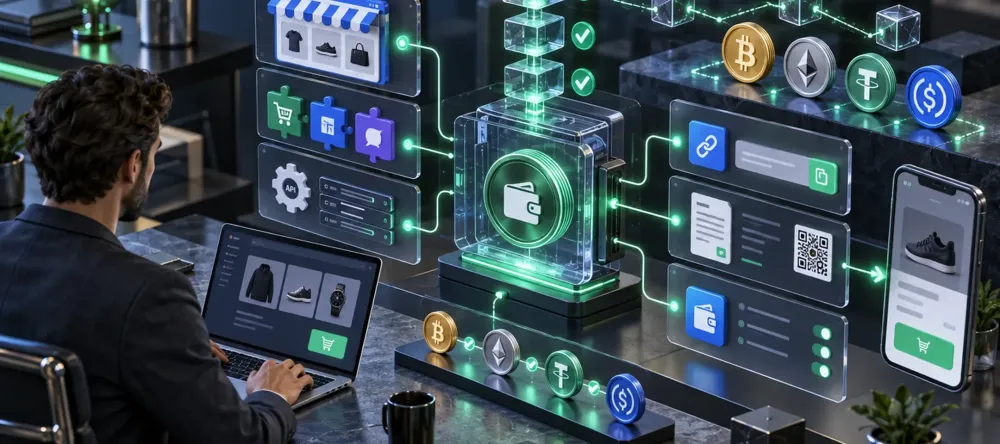
Cryptocurrency payments are gradually becoming an additional payment channel for companies serving an international audience. Businesses no longer need to manage wallets, blockchain infrastructure, and transaction tracking themselves: a significant portion of these tasks can be outsourced to a payment provider.
However, enabling cryptocurrency payments involves several decisions: which assets to accept, what currency to receive settlements in, which integration method to use, how to process payment statuses, and what to do with non-standard transactions. Below, we'll break down the entire process step by step.
What does accepting cryptocurrency even mean?
In simple terms, a cryptocurrency payment is a transfer of a digital asset from a customer's wallet to an address associated with the merchant.
If we look at the technical side, a business can do everything independently, without an intermediary. It's necessary to create wallets, generate addresses, monitor multiple blockchain networks simultaneously, and manually reconcile incoming transactions with the corresponding orders. But from what's described, it quickly becomes clear that this isn't an easy task.
For this reason, many businesses choose to use a cryptocurrency payment gateway rather than manage the entire payment infrastructure in-house.
Essentially, a cryptocurrency payment gateway acts as a layer between the merchant's system and the blockchain. A business connects its website, app, or billing system to a provider. The provider then handles much of the underlying blockchain and payment-processing infrastructure.
How cryptocurrency payments work
Let's say we have an online service that sells a subscription for 100 euros.
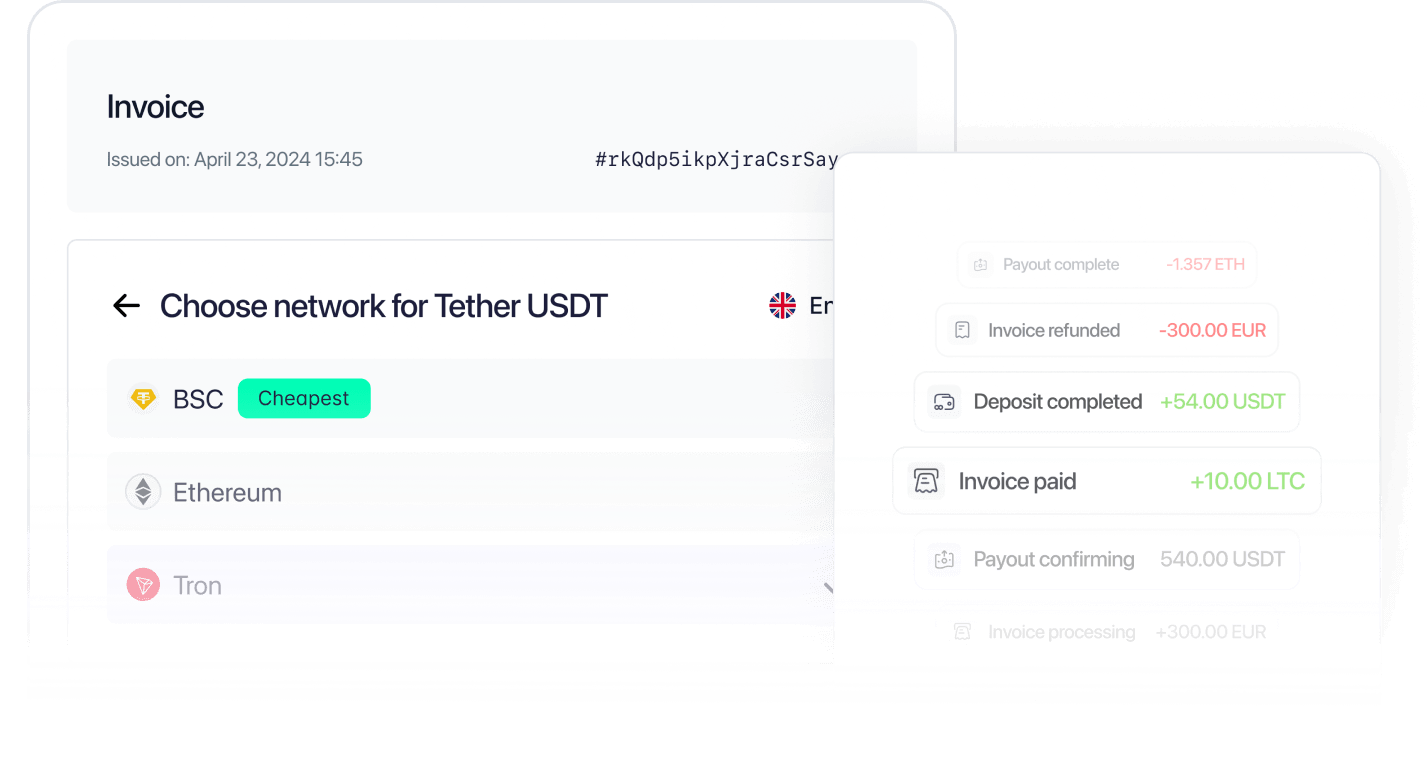
The customer selects cryptocurrency as a payment method. The merchant's system transmits the order details to the payment provider. The provider creates an invoice and calculates the equivalent amount in the selected cryptocurrency at the current exchange rate. After this, the customer receives payment details: address, amount, network name, and, usually, a QR code.
Once the customer broadcasts the transaction, the payment provider begins monitoring it on the relevant blockchain. Once the payment meets the provider's confirmation requirements, the invoice status is updated, and the merchant's system receives a notification - usually via a webhook or API. After this, the subscription can be automatically activated, the digital product issued, the user's balance topped up, or the order processed.
Funds can be held in the original asset, converted into a stablecoin, or settled in fiat where supported by the provider.
How to accept cryptocurrency payments: A step-by-step process
Step 1. Determine which assets to accept and in what currency to receive funds
The first decision is to separate what the customer pays with and what the business ultimately wants to receive.
For example, a crypto checkout can allow customers to pay with Bitcoin, Ethereum, USDT, and USDC. Depending on the provider's capabilities, incoming funds can be left in the original cryptocurrency, automatically converted to a stablecoin, or received in another supported currency.
At this stage, the business needs to determine:
- Which cryptocurrencies are truly needed by its audience
- Which blockchain networks will be supported
- Is the company prepared to hold volatile assets?
- Is automatic conversion required?
- What currency does the company want to receive and record revenue in?
Step 2. Choose an integration method
A ready-made plugin is suitable for online stores running on a CMS or e-commerce platform. This is one of the simplest options if the goal is to add a crypto checkout alongside existing payment methods without developing a custom payment module.
Payment links and invoices are suitable for B2B payments, services, and one-time invoices. In this scenario, a full-fledged checkout may not be necessary at all: the company creates a payment link or invoice and sends it to the client.
API integration is suitable for companies with their own platform, checkout, billing system, or internal user balances. It allows you to programmatically create invoices, retrieve payment statuses, process refunds, and link payment events to internal business logic.
Individual deposit addresses are used in a different scenario: when users regularly top up their balance within the platform. Instead of creating a new invoice for each payment, a separate address is assigned to each user, and incoming transactions are automatically linked to their account.
Step 3. Complete KYB and onboarding
Before launching into production, a business typically needs to complete onboarding with the payment provider.
For corporate clients, this process typically includes KYB (Know Your Business). The provider verifies the legal entity, ownership structure, business activities, and other data required for compliance.
Therefore, it's advisable to conduct KYB in parallel with technical integration rather than leaving it until the very end.
Step 4. Configure checkout, plugin, or API
After onboarding, you can move on to setting up the payment process itself.
For checkout, you need to determine which assets and networks will be available to the user, the validity period of the invoice, how the exchange rate is displayed, and what instructions the client receives before payment. With API integration, the backend typically creates an invoice after the order is placed and stores its ID along with the internal order ID. This allows a specific blockchain transaction to be linked to the corresponding order, user, or account.
It's important to consider more than just the two final states - "paid" and "not paid." A payment can go through several intermediate stages before completion: invoice created, waiting for payment, transaction detected, confirming, paid, expired, or failed. The specific set of statuses depends on the provider.
Step 5. Configure webhooks and payment status processing
For an automated payment flow, simply having a transaction appear in the blockchain is not enough. Typically, a provider sends a webhook when an invoice status changes: for example, when a transaction is detected, receives the required number of confirmations, or reaches the final status.
The business system then performs the required action: confirming the order, activating the subscription, issuing the digital product, or crediting the user's balance. Webhook processing must be idempotent. If the same notification is received repeatedly, the system should not issue the product, reactivate the subscription, or re-credit the funds.
Step 6. Test the payment flow
Before launch, it is important to test more than just the ideal scenario in which the client sends the correct amount through the correct network and the payment is quickly confirmed.
The minimum set of tests should include:
- payment of the correct amount;
- delayed blockchain confirmations;
- underpayment;
- overpayment;
- payment after invoice expiration;
- use of the wrong network;
- webhook re-delivery;
- refund;
- API delays or temporary unavailability.
If the provider provides a sandbox or test environment, it's best to test key integration scenarios before enabling production payments.
Step 7. Launch payments and monitor results
After launch, it's important to look not only at the number of successfully completed payments but also at the reasons for failed or unfinished transactions.
For example, a high percentage of expired invoices may indicate that customers don't have enough time to pay. A large number of underpayments or wrong-network cases may indicate that the checkout doesn't clearly display the amount or selected network.
What happens if a cryptocurrency payment doesn't go as planned?
In practice, not every payment follows the ideal scenario. A customer may send funds after the invoice expires, select the wrong network, or request a refund. It's best to consider such situations before launch.
Expired invoice
A crypto invoice is usually valid for a limited time, as the value of the cryptocurrency relative to the order currency can fluctuate. If a client sends a payment after the expiration date, the initial cryptocurrency amount cannot be automatically assumed to still correspond to the order value.
Depending on the provider's policies, such a payment may be marked as a late payment and require separate processing: acceptance at the current exchange rate, a refund, or a manual review.
Wrong network
The same asset can exist in multiple blockchain networks. If a client sends funds through a network that is not supported for the specified address, the system may not automatically recognize the payment.
In some cases, recovery is technically possible, but this depends on the provider's infrastructure and should not be considered a guaranteed scenario. Therefore, the asset and network must be clearly and prominently indicated in the checkout.
Confirmations
The appearance of a transaction in the blockchain does not necessarily mean the payment is final. After detecting a transaction, the provider may first assign it an intermediate status, such as detected or confirming, and may only consider the invoice paid once its confirmation requirements have been met.
Therefore, it's better to tie internal business logic to the final payment status, rather than simply the appearance of a transaction hash.
Refunds
A confirmed on-chain payment cannot simply be reversed at the protocol level. If a customer requires a refund, the merchant or payment provider initiates a new outgoing transaction.
Therefore, a separate refund flow is needed for crypto payments. Businesses should determine in advance:
- Who can initiate a refund
- How the destination address is verified
- Who pays the network fee
- Whether the original amount of cryptocurrency or an equivalent amount for the order is refunded
- Whether manual approval is required before sending funds
For which businesses are cryptocurrency payments particularly relevant?
Cryptocurrency payments are particularly relevant to business models with international customers and digital product delivery.
These include e-commerce, SaaS, hosting, software, and digital goods, where a confirmed payment can be directly linked to the automatic delivery of a product or service activation.
What risks should be considered?
One of the main risks is volatility. If a company accepts an asset and continues to hold it, its value may change after the product or service is sold. Automatic conversion to a stablecoin or fiat currency can reduce this risk, although it does not eliminate it completely.
Blockchain transparency also does not automatically mean that every transaction is low-risk from a compliance perspective. Businesses may require AML monitoring, sanctions screening, Know Your Transaction (KYT), and provenance analysis.
Another important issue is infrastructure security. If a company independently manages wallets, private keys, and blockchain infrastructure, it assumes additional operational and custody risks.
Cryptocurrency payments in the EU
In the European Union, the Markets in Crypto-Assets Regulation (MiCA) establishes a harmonized framework for crypto-assets and crypto-asset service providers. MiCA defines authorization, corporate governance, and compliance requirements for companies providing regulated crypto services. In Germany, for instance, BaFin is the competent authority responsible for authorizing and supervising crypto-asset service providers under MiCA.
Merely accepting Bitcoin or USDT as payment does not automatically make a merchant a crypto-asset service provider. Regulatory obligations depend on which operations the business performs internally and which functions it outsources. For companies operating in Germany or elsewhere in the EU, it is therefore especially important to understand the provider's legal structure, its AML and KYB requirements, as well as how it handles suspicious transactions and sanctions screening.
How to choose a provider for accepting cryptocurrency payments
Comparisons of providers often begin with fees and the number of supported cryptocurrencies. These are important parameters, but they are not sufficient for businesses.
Pay attention to settlement. Can the provider automatically convert incoming cryptocurrency? Can the business receive funds in fiat, stablecoins, or other supported digital assets?
It's also important to understand which networks are available for each asset and how flexible the settlement flow is.
The next criterion is integration. The provider must support a model that aligns with the business's current architecture and scalability plans. Transaction transparency is equally important. The team should be able to see the payment status, exchange rate used, confirmation history, and settlement results.

Compliance infrastructure should also be assessed separately: KYT, AML controls, sanctions screening, and blockchain transaction monitoring should be part of the provider selection process, not a task that only appears after the launch. Operational tooling is also important for day-to-day operations. The finance team may need transaction history, reconciliation, reporting, and data export, while the technical team may need API documentation, reliable webhooks, and clear payment status logic.
How to accept cryptocurrency payments with Sheepy
With Sheepy, the setup process follows the same basic flow: create a business account, complete verification, set up an Integration Profile, select the assets to accept and the preferred settlement currency, and then enable the appropriate integration method.
1. Create an account and complete verification
The first step is to register a business account with Sheepy and complete verification.
For corporate clients, this process includes company verification and the necessary corporate documents. Once KYB is completed, the account gains access to production services.
2. Set up an integration profile
Configure the basic payment acceptance parameters: integration name, domain, preferred currency, and the cryptocurrencies that will be available to clients.
At this stage, you can also configure asset conversion, for example, accepting multiple cryptocurrencies but automatically converting all or part of the proceeds to the selected settlement currency.
3. Choose an integration method
For companies with their own checkout or billing system, Sheepy provides an API. It can be used to create invoices, manage transactions, addresses, refunds, and other payment flow elements.
For e-commerce, ready-made plugins are available that allow you to add crypto payments without developing a separate payment module from scratch. For platforms with regular deposits, you can use deposit addresses, and for payout scenarios, mass payouts.
4. Configure payment statuses and notifications
Sheepy allows you to track key events for invoices, withdrawals, payouts. For automated scenarios, payment statuses should be linked to business logic: for example, only after receiving the required status will the system activate a subscription, issue a product, or top up a user's balance.
5. Test the integration and launch production
Before launching, it's worth checking invoice creation, receiving payment statuses, confirmations, refunds, and key edge cases.
After completing verification and testing, the integration can be moved to production. And then the Sheepy dashboard can be used for monitoring, transaction history, reconciliation, and reporting.
Making crypto payments work for your business
In 2026, accepting cryptocurrency payments no longer necessarily means building wallets, blockchain monitoring, and conversion infrastructure in-house. For most companies, the more important decision is which parts of this infrastructure truly make sense to control themselves. The payment provider can handle the blockchain work, while the business can focus on the product, customer experience, and its own payment system.
Sheepy helps leading iGaming, FX, and E-commerce brands grow their crypto payments - trusted since 2022.


'%3e%3cpath%20d='M5.33337%2017.3333C5.76671%2020.7093%207.84137%2023.708%2010.6667%2025.3333'%20stroke='%231C1D3B'%20stroke-width='2'%20stroke-linecap='round'%20stroke-linejoin='round'/%3e%3cpath%20d='M26.6667%2014.6667C26.3406%2012.3203%2025.2521%2010.1462%2023.5688%208.47934C21.8856%206.81246%2019.701%205.74524%2017.3516%205.44209C15.0021%205.13893%2012.6182%205.61666%2010.5669%206.80168C8.51571%207.98669%206.911%209.81326%206%2012'%20stroke='%231C1D3B'%20stroke-width='2'%20stroke-linecap='round'%20stroke-linejoin='round'/%3e%3cpath%20d='M5.33337%206.66666V12H10.6667'%20stroke='%231C1D3B'%20stroke-width='2'%20stroke-linecap='round'%20stroke-linejoin='round'/%3e%3cpath%20d='M16%2020H18.6667C19.0203%2020%2019.3594%2020.1405%2019.6095%2020.3905C19.8595%2020.6406%2020%2020.9797%2020%2021.3333V22.6667C20%2023.0203%2019.8595%2023.3594%2019.6095%2023.6095C19.3594%2023.8595%2019.0203%2024%2018.6667%2024H17.3333C16.9797%2024%2016.6406%2024.1405%2016.3905%2024.3905C16.1405%2024.6406%2016%2024.9797%2016%2025.3333V26.6667C16%2027.0203%2016.1405%2027.3594%2016.3905%2027.6095C16.6406%2027.8595%2016.9797%2028%2017.3333%2028H20'%20stroke='%231C1D3B'%20stroke-width='2'%20stroke-linecap='round'%20stroke-linejoin='round'/%3e%3cpath%20d='M24%2020V22.6667C24%2023.0203%2024.1405%2023.3594%2024.3905%2023.6095C24.6406%2023.8595%2024.9797%2024%2025.3333%2024H26.6667'%20stroke='%231C1D3B'%20stroke-width='2'%20stroke-linecap='round'%20stroke-linejoin='round'/%3e%3cpath%20d='M28%2020V28'%20stroke='%231C1D3B'%20stroke-width='2'%20stroke-linecap='round'%20stroke-linejoin='round'/%3e%3c/g%3e%3cdefs%3e%3cclipPath%20id='clip0_17690_160'%3e%3crect%20width='32'%20height='32'%20fill='white'/%3e%3c/clipPath%3e%3c/defs%3e%3c/svg%3e)
'%3e%3cpath%20d='M10.6667%208.00001C10.6667%207.29277%2010.9477%206.61449%2011.4478%206.11439C11.9479%205.61429%2012.6262%205.33334%2013.3334%205.33334H24.0001C24.7073%205.33334%2025.3856%205.61429%2025.8857%206.11439C26.3858%206.61449%2026.6667%207.29277%2026.6667%208.00001V18.6667C26.6667%2019.3739%2026.3858%2020.0522%2025.8857%2020.5523C25.3856%2021.0524%2024.7073%2021.3333%2024.0001%2021.3333H13.3334C12.6262%2021.3333%2011.9479%2021.0524%2011.4478%2020.5523C10.9477%2020.0522%2010.6667%2019.3739%2010.6667%2018.6667V8.00001Z'%20stroke='%231C1D3B'%20stroke-width='2'%20stroke-linecap='round'%20stroke-linejoin='round'/%3e%3cpath%20d='M5.33337%2013.3333C5.33337%2012.6261%205.61433%2011.9478%206.11442%2011.4477C6.61452%2010.9476%207.2928%2010.6667%208.00004%2010.6667H18.6667C19.374%2010.6667%2020.0522%2010.9476%2020.5523%2011.4477C21.0524%2011.9478%2021.3334%2012.6261%2021.3334%2013.3333V24C21.3334%2024.7072%2021.0524%2025.3855%2020.5523%2025.8856C20.0522%2026.3857%2019.374%2026.6667%2018.6667%2026.6667H8.00004C7.2928%2026.6667%206.61452%2026.3857%206.11442%2025.8856C5.61433%2025.3855%205.33337%2024.7072%205.33337%2024V13.3333Z'%20stroke='%231C1D3B'%20stroke-width='2'%20stroke-linecap='round'%20stroke-linejoin='round'/%3e%3c/g%3e%3cdefs%3e%3cclipPath%20id='clip0_17690_177'%3e%3crect%20width='32'%20height='32'%20fill='white'/%3e%3c/clipPath%3e%3c/defs%3e%3c/svg%3e)